What Your Ryokan Host Already Knows About You (Before You Even Unpack)
You walk through the noren curtain, slip off your shoes, and try to remember which foot goes first. You're jet-lagged, slightly unsure of the etiquette, and quietly hoping you don't do anything embarrassing in the first five minutes. What you probably don't realize is that your host already knows most of this — and has already started adjusting.
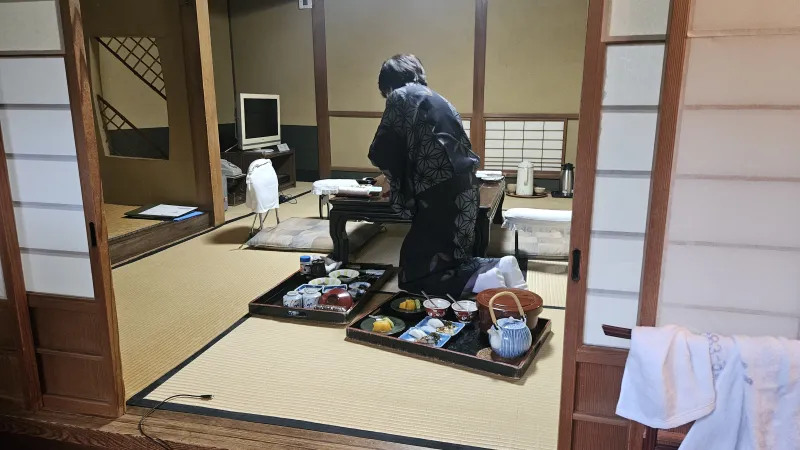
This is the part of ryokan hospitality that doesn't make it into the brochures. The visible stuff — the kaiseki dinner, the yukata, the hinoki wood bath — those are easy to photograph and describe. But the deeper skill at work is something closer to cultural fluency: the ability to read a guest's unspoken state and respond without ever making them feel observed.
We talked to innkeepers across Japan — some running properties that have been in their families for four and five generations — about what they've learned from hosting American travelers specifically. The answers were illuminating.
They Can Spot Jet Lag Before You Mention It
Yoshiko, who manages a twelve-room inn in Kyoto that her grandmother opened in the 1960s, says she can identify a jet-lagged guest within minutes of arrival. "The eyes," she says simply. "And the way they stand. They are trying very hard to be present, but they are not fully here yet."
What changes? Almost everything, invisibly. The check-in conversation becomes shorter. The tour of the room is abbreviated to just the essentials. Tea appears faster. The dinner timing, if the guest has any flexibility, gets nudged earlier. Nobody announces these adjustments. They simply happen.
For American travelers, this can feel almost uncanny — the sense that the inn anticipated what they needed without being told. But it's not magic. It's pattern recognition built over decades of watching people arrive exhausted from long-haul flights and figuring out what actually helps versus what adds to the overwhelm.
"Americans often want to be good guests immediately," Yoshiko adds. "They want to ask questions, learn the rules, do everything right. Sometimes the most helpful thing is to let them rest first and learn later."
Personal Space Is a Language, and They've Learned to Read It
Japanese hospitality culture is built around proximity and attentiveness — a level of presence that can read as intrusive to guests accustomed to more transactional service. Experienced ryokan hosts who work with Western travelers have spent years recalibrating this.
Kenji, a third-generation innkeeper in the Izu Peninsula, describes it as learning a second hospitality dialect. "In Japan, being close is care. But I noticed American guests would sometimes step back slightly when I stood near them. Not rudely — just reflexively. So I learned to adjust my distance. Same warmth, different geometry."
This kind of micro-adjustment — invisible to the guest, deeply considered by the host — is what separates a good ryokan experience from a great one. The inn's care doesn't disappear; it just reshapes itself to fit the person receiving it.
What's worth knowing as a traveler: your body language is communicating constantly, and a skilled host is reading it. If you're tense, they'll give you more space. If you seem curious and open, they may linger a bit longer to explain something about the meal or the garden. You don't have to perform ease — but the more relaxed you actually are, the richer the interaction tends to become.
The Questions Americans Ask (And What They Actually Mean)
American guests ask a lot of questions. This is neither a criticism nor a compliment — it's just a cultural fact that innkeepers have learned to work with. The interesting part is what those questions often signal beneath the surface.
"When a guest asks if the onsen is okay for them," says Hiromi, who runs a small inn in Yamagata known for its sulfuric hot springs, "they are usually not asking about the water chemistry. They are asking: Will I be judged? Will I do it wrong? Is my body acceptable here?" She pauses. "So I answer all of those questions, not just the one they asked."
This is sophisticated hospitality. It requires not just cultural knowledge but genuine empathy — the ability to hear the anxiety behind the words and respond to the whole person rather than the literal inquiry.
For American travelers, understanding this can reframe how you interact with ryokan staff. You don't need to over-explain your questions or apologize for not knowing things. The good innkeepers have already heard the question underneath your question, and they're already answering it.
What Gets Lost in Translation (And What Doesn't Need Words)
Language barriers are real, and not every ryokan has English-speaking staff. But innkeepers who've hosted Western guests for years are remarkably clear on one point: the most important communication doesn't happen in words.
A guest who bows slightly when receiving their meal — even imperfectly — communicates respect. A guest who pauses in the garden instead of walking straight through communicates that they're paying attention. A guest who tries the unfamiliar dish before reaching for the familiar one communicates openness. None of this requires a shared language.
"I have had guests who spoke no Japanese and I spoke very little English," says Kenji. "But we understood each other perfectly by the end of two days. You can feel when someone is grateful. You can feel when someone is at ease. These things don't need translation."
For American travelers, this is actually good news. You don't need to master Japanese etiquette to have a meaningful experience at a ryokan. But a little intentionality goes a long way — slowing down, being present, noticing what's been prepared for you and acknowledging it, even wordlessly.
What They Wish You Knew Before You Arrived
We asked innkeepers directly: if you could tell your American guests one thing before they checked in, what would it be?
The answers varied in phrasing but converged on the same idea: let yourself be taken care of.
"American guests sometimes work very hard to need nothing," Yoshiko says. "They don't want to be a burden. But our whole purpose is to care for you. When you let us do that, we can do it well. When you resist it, we both miss something."
That's worth sitting with before your next trip. The ryokan isn't a hotel where you manage your own experience. It's a place where someone else has thought carefully about what you need — and is quietly, skillfully providing it. Your job, more than anything, is just to show up and let it happen.