Quiet on Purpose: How Japan's Traditional Inns Rewire an Overstimulated American Brain
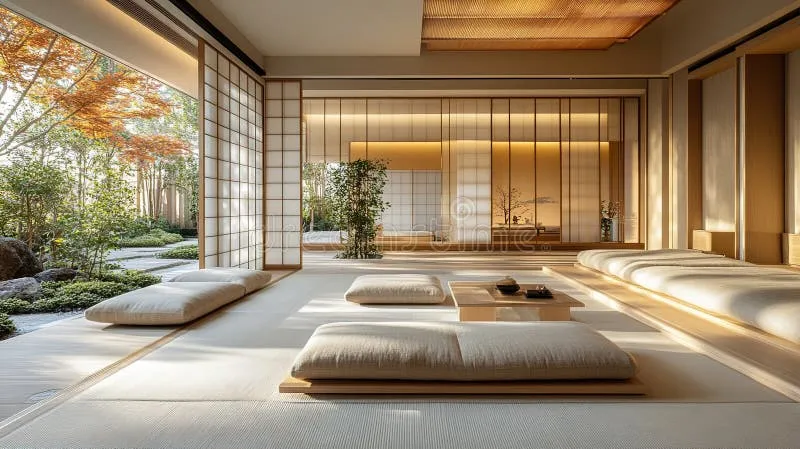
Photo: minimalist Japanese ryokan tatami room with garden view and shoji screens, via thumbs.dreamstime.com
Let's be honest: most Americans don't know how overstimulated they are until the stimulation stops.
You land in Japan, check into a ryokan, slide open the shoji screen to your room, and something strange happens. The mental static—the kind you've been living with so long you forgot it was there—starts to lift. There's no flat-screen TV mounted to the wall cycling through cable news. No minibar stuffed with snacks engineered to grab your attention. No lobby playlist pumping lo-fi beats. Just a low wooden table, a folded futon waiting in the closet, a ceramic teapot, and a window framing a garden that looks like someone painted it.
This isn't an accident. It's philosophy in action.
What 'Ma' Actually Means (And Why Americans Are Starved for It)
In Japanese aesthetics, there's a concept called ma (間)—often translated as "negative space" or "interval." But that translation barely scratches the surface. Ma isn't just the absence of something. It's a presence in itself. It's the pause between musical notes that gives the melody meaning. It's the empty corner of a room that makes the whole space breathe.
Western design philosophy, especially in American hospitality, tends to fill space. More amenities, more features, more options. The assumption is that more equals better, and that a guest who runs out of things to look at or do is an unhappy guest.
Japanese traditional inn design operates from the opposite premise. A tatami room with a single hanging scroll and a flower arrangement in the tokonoma alcove isn't sparse—it's intentional. Every element earns its place. And what's left out is just as considered as what's included.
For a brain that's been mainlining Instagram, Slack notifications, and 24-hour news, walking into a room designed around ma can feel genuinely disorienting at first. Then, usually within a few hours, it starts to feel like medicine.
The Room Is the Experience
At most American hotels—even the nice ones—the room is a place to sleep between activities. The real experience happens elsewhere: at the rooftop bar, the spa, the concierge-recommended restaurant two blocks away.
At a ryokan or minshuku, the room is the experience. Meals are often brought to you there. You change into a yukata (a light cotton robe provided by the inn) and you don't really need to leave. The garden outside your window isn't decorative—it's something to actually sit and watch, the way you might watch a fire or the ocean.
This shift from "doing" to "being" is harder than it sounds for most American travelers. We're culturally wired to optimize our time, to see passive stillness as laziness. But ryokans gently dismantle that impulse. There's simply less to react to, which means your brain gradually stops scanning for the next thing and starts settling into the present one.
Psychologists sometimes call this "attentional restoration"—the idea that natural, low-stimulation environments allow the parts of your brain responsible for directed focus to recover. Traditional Japanese inn environments, almost by design, tick every box researchers associate with restorative spaces: natural materials, greenery, soft light, minimal noise, and a sense of being pleasantly removed from ordinary life.
Minshuku: The Quieter Cousin Worth Knowing About
If ryokans are the headlining act, minshuku are the hidden gem. These family-run guesthouses operate on a similar philosophy—traditional architecture, simple rooms, home-cooked meals—but with a more informal, lived-in energy. Think of it like staying with a Japanese family who happens to have a couple of spare tatami rooms.
Minshuku tend to be quieter even than ryokans, partly because they're smaller and often located off the main tourist trail. In a mountain minshuku in Nagano or a coastal one along the Izu Peninsula, the loudest thing you're likely to hear at night is rain on the roof tiles or the distant sound of a river. For someone coming from, say, Chicago or Los Angeles, that kind of quiet can feel almost supernatural.
And that's exactly the point. At On Yado, we often hear from travelers who say the minshuku stay was the part of their trip they think about most—not because anything dramatic happened, but because nothing did, and they'd forgotten what that felt like.
Practical Ways to Lean Into the Quiet
If you want to actually absorb what a traditional inn is offering rather than spending it doom-scrolling on your phone, a few small shifts go a long way:
Leave the TV off (if there even is one). Many ryokan rooms don't have televisions at all. If yours does, try treating it like a challenge to leave it dark.
Put your phone on airplane mode after dinner. The inn's schedule—bath time, meal time, lights-out—naturally structures your evening in a way that makes this easier than it sounds.
Spend time in the garden. Japanese inn gardens are designed for contemplation, not just photography. Pull up a chair or sit on the engawa (the narrow wooden veranda) and just look. Twenty minutes of this tends to do more than an hour of meditation-app guided breathing.
Let meals take as long as they take. Ryokan dinners aren't designed to be efficient. They're designed to be experienced course by course, at a pace that feels almost comically slow by American standards. Let it be slow.
Wake up before breakfast and walk the grounds. Early morning at a traditional inn—before the other guests are moving, when the garden is still dewy and the staff are quietly preparing the day—is one of the most genuinely peaceful experiences available to a traveler anywhere in the world.
The Noise Was Always Optional
Here's the thing nobody tells you before you go: you'll probably feel a little restless on the first night. Maybe even the second. The quiet will feel like something's missing rather than something added.
That restlessness is informative. It's your nervous system noticing the absence of its usual inputs and not quite knowing what to do. Most travelers report that by night three, the feeling flips entirely—and the thought of going back to a noisy hotel room starts to seem genuinely unappealing.
Japan's traditional inns aren't selling luxury in the Western sense. They're selling something rarer: a designed environment where the default state is calm, and where the guest is trusted to find that valuable. For Americans who've been overscheduled and overstimulated for years, that trust—and that quiet—might be the most meaningful souvenir they bring home.