Your Futon Is Trying to Tell You Something About How You Sleep
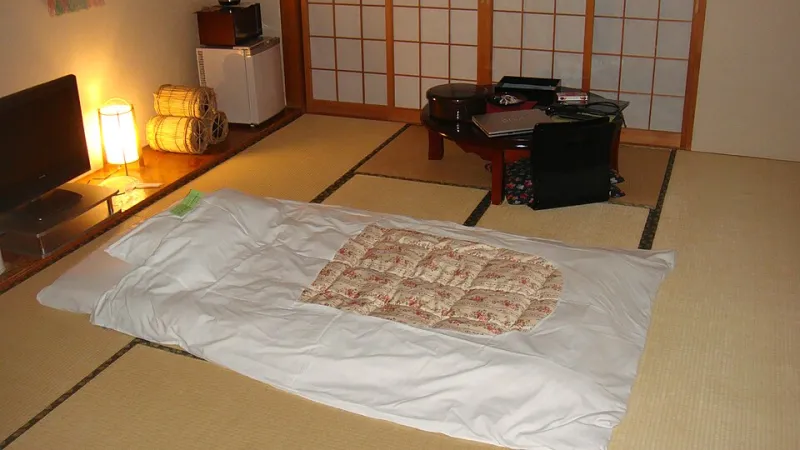
Photo: David McKelvey, CC BY 2.0, via Wikimedia Commons
The first time you walk into a traditional Japanese room, the bed doesn't exist. There's tatami, a low table, maybe a tokonoma alcove with a scroll in it, and a closet. That's it. The bed is in the closet. It comes out later, and it goes away again in the morning.
I slept on futons for the better part of two weeks on a recent trip, and I came home with more opinions about bedding than I've formed in a decade of mattress shopping. Here's what actually happens.
The room gets smaller at night, in a good way
Around six or seven in the evening, usually while you're at dinner, someone slides open the closet, unrolls a shikibuton across the tatami, lays a kakebuton quilt on top, and sets out a pillow. By the time you come back from the bath, the room has changed shape.
There's something quietly satisfying about this. The room does two jobs — daytime sitting room, nighttime bedroom — and it does them sequentially rather than simultaneously. You never have a bed sitting in the corner of the room reminding you that you should be asleep.
The pillow will be the first surprise
Forget everything you know about pillows. The traditional option is often a small, firm cushion filled with buckwheat hulls or soba chaff, sometimes with a rice-bran filling. It doesn't cradle your head so much as hold it up.
Most inns will also provide a softer Western-style pillow or a buckwheat pillow you can adjust by removing filling. Ask. Nobody will be offended, and the difference between a good night and a stiff neck is one sentence at check-in.
What your back says at 2 a.m.
A futon on tatami is firm. Not rock-hard, but firmer than almost any mattress an American has slept on. Tatami itself has a little springiness from the woven rush over its core, which softens things more than people expect.
Side sleepers often notice pressure on the hip and shoulder first. Back sleepers tend to adapt quickly. Stomach sleepers struggle most, because there's nothing to sink into.
If your inn's futon feels too thin, say so. Staff will often add a second shikibuton underneath, which is a completely normal request and takes about thirty seconds to solve.
You probably won't be cold
This one surprises people. The floor is cold in winter, right? In practice, a good ryokan puts a thick shikibuton down, adds a heavy kakebuton, and often provides a blanket layer beneath you. Japanese bedding is engineered for unheated rooms, and it works.
If anything, the risk runs the other way — overheating, because you're buried under a quilt designed for a house with no central heating.
The floor changes your morning
Here's the part I didn't expect. When you sleep on the floor, you get up differently. There's no swinging your legs over the edge of a tall mattress. You roll, push up, stand — a small but real piece of mobility work before you've had coffee.
And because the bedding disappears the moment you're up, the room is instantly a room again. No unmade bed, no rumpled sheets, no visual evidence of last night. You drink tea at a low table in a clean space and the day starts with a strange, quiet clarity.
What you notice about home
By night three, I'd compiled a list of things about my own bedroom that annoyed me.
- My mattress is probably too soft, and I'd been blaming my lower back on everything else.
- My pillow is doing almost nothing.
- My bedroom has too much stuff in it, and some of that stuff is a bed.
- I sleep with my phone on the nightstand, which a tatami room doesn't have.
That last one is not a small thing. In a traditional room there's no nightstand, no lamp beside your head, no obvious place to put a phone. You set it across the room, or you leave it in your bag, and you fall asleep without the last thing you see being a screen.
How to sleep well on a futon
A few practical notes, learned the hard way:
- Ask for an extra shikibuton if you're a side sleeper or over about 190 pounds.
- Request a pillow swap early, not at midnight.
- Keep the room cool and the quilt on. Layering beats a warm room.
- Go easy on the sake at dinner. The futon is unforgiving about dehydration.
- Give it two nights. The first is an adjustment; the second is usually better than any hotel bed on the trip.
The morning after
I flew home, slept in my own bed, and woke up oddly disappointed. The mattress felt like a cloud that had given up. I'd spent years assuming my sleep setup was fine because I had nothing to compare it to.
One night on tatami won't fix your sleep. But it will hand you a set of questions about it — and for a lot of travelers, that turns out to be the most useful souvenir they bring back.