Six Months Later, You're Still Thinking About That Inn
You've probably had this conversation. Someone mentions Japan, and a friend lights up — not about Tokyo's skyline or a bullet train ride, but about the inn. The one with the sliding paper doors. The bath that smelled like cedar and minerals. The meal that arrived in twelve tiny dishes, each one a small mystery. And this isn't a fresh memory. This friend stayed there eight months ago. Maybe longer.
That's not normal vacation behavior. Most trips dissolve into a comfortable blur within a few weeks. But ryokan stays seem to resist that fade. They linger. They rearrange things. So what's actually going on?
Your Brain Remembers Experiences Differently Than Information
Psychologists who study memory and emotion have a term for it: the peak-end rule. We don't remember experiences as averages — we remember them by their most intense moments and how they ended. A ryokan is practically engineered around both of those things.
The moment you step off your shoes at the entrance and feel the cool wood of the genkan beneath your feet, something shifts. The inn's staff appears — not rushing, not performing, just present. That arrival sequence, quiet and deliberate, is already encoding itself as a peak moment. And the checkout? Ryokans famously treat the goodbye as a ceremony in itself, with staff often walking guests to the gate and bowing until the car disappears. That's not theater. It's a considered ending — and your brain files it accordingly.
Compare that to a standard hotel checkout: a receipt slid under the door, a keycard dropped in a box, a lobby you barely glance at on your way to the Uber. The experience ends with a shrug. No wonder it fades.
The Unplugged Hours You Didn't Know You Needed
Talk to returning ryokan guests and a pattern emerges fast. Nearly all of them mention — with a kind of wonder — how little they looked at their phones.
That's not an accident. Traditional inns aren't designed around connectivity. The rooms don't have televisions in many cases. The aesthetic is spare. The sound landscape is birdsong, wind in bamboo, water moving somewhere nearby. When your nervous system stops bracing for the next notification, it starts actually resting. And experiences absorbed in that state — calm, present, unhurried — tend to stick.
Sarah, a marketing director from Austin who stayed at a small inn in Kyoto's Higashiyama district, put it plainly: "I sat in my room for two hours doing nothing. I haven't done that in ten years. I remember every detail of those two hours. I can't tell you what I was doing on my phone the week before I left."
That contrast is significant. We're increasingly aware that passive scrolling produces almost no memorable experience. But deep presence — the kind that ryokan design quietly enforces — creates the conditions for memory to actually form.
The Human Connection That Doesn't Perform
One thing returning guests consistently struggle to articulate is how the staff made them feel. Not what they did, but how it felt. Words like "seen" and "cared for" come up a lot. So does the phrase "I don't know how they knew."
This is omotenashi — a concept of hospitality that anticipates needs rather than reacting to them. It's not a script. It's a practice, often developed over generations. And for American travelers accustomed to service that ranges from efficient to indifferent, encountering something genuinely attentive can be disorienting in the best way.
Marcus, a software engineer from Seattle who visited a ryokan in the Hakone region, described it like this: "I mentioned offhand on the first night that I was a light sleeper. The next morning, the futon had been moved to a different part of the room — away from the garden path where the staff walked early. Nobody asked. Nobody made a thing of it. It was just done."
That kind of interaction doesn't just make you feel comfortable. It makes you feel known. And we remember the people and places that made us feel known long after we've forgotten the ones that merely served us well.
The Design of Slowness
Ryokans don't give you a lot to do. That's the point — and it's also, for many American travelers, the initial source of anxiety.
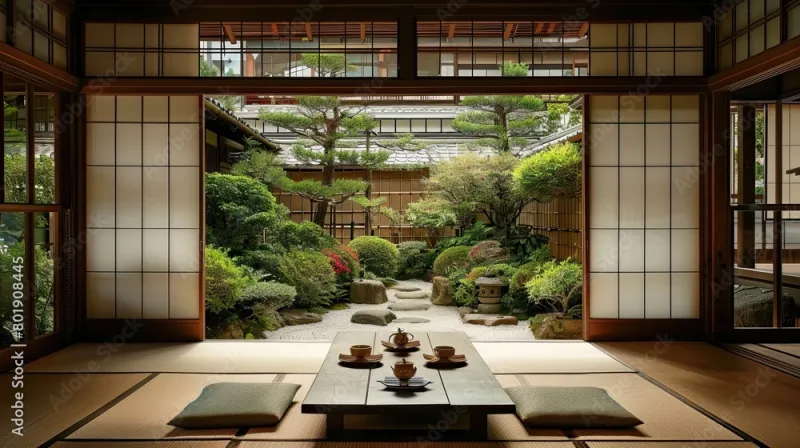
We're trained to optimize vacation time. Itineraries. Reservations. Lists of "must-sees." A ryokan gently dismantles all of that. Dinner is served at a set time. The bath has its own rhythm. The room itself — tatami floors, a low table, a window framing a garden — doesn't invite busyness. It invites sitting. Watching. Being.
This enforced deceleration turns out to be profoundly memorable because it's so rare. Most of us haven't experienced genuine, unscheduled stillness since childhood. When we encounter it at a ryokan, it registers as something almost archaeological — a version of rest we'd forgotten existed.
Jennifer, a nurse from Chicago who stayed at a rural inn in Nagano, said she started waking up earlier after she got home. "I kept trying to recreate that morning feeling — the quiet, the light, the tea before anything else happened. I haven't totally figured it out, but I'm still trying. That was seven months ago."
Why It Keeps Influencing Life Back Home
This might be the most striking part of the ryokan effect: it doesn't stay in Japan. Guests come back and start clearing clutter from their homes. They buy Japanese ceramics. They take baths instead of showers. They try to eat more slowly. They start saying no to plans that don't feel intentional.
These aren't just souvenirs of a trip. They're behavioral echoes — attempts to reconstruct, in an American context, the feeling that the inn produced. The ryokan showed them something about how life could feel, and they haven't been able to shake it.
That's the real measure of a lasting experience. Not whether you'd go back (you would), but whether it changed something in you that stayed changed.
And if you're already researching your next trip to Japan with a list of inns instead of hotels, you already know what we're talking about.